0%

Choosing Surgical Robotics End Effectors is not a catalog exercise. It is a clinical, engineering, and workflow decision. The right instrument must match tissue behavior, surgical access, surgeon preference, and reprocessing capacity. Intuitive Surgical’s 2023 Annual Report recorded more than 2.2 million da Vinci procedures worldwide. It also reported over 8,600 installed systems. That scale shows the market’s maturity, but it does not prove that every end effector fits every procedure. Grand View Research estimates that the global surgical robots market will continue expanding through 2030. Consequently, buyers need stronger selection criteria than brand recognition.

Dr. Mehran Anvari, a recognized robotic surgery pioneer, has emphasized a practical principle: “The robot does not do the surgery; the surgeon does.” This reminder matters when comparing graspers, scissors, needle drivers, staplers, and energy instruments. Evaluate wrist articulation, jaw force, tactile feedback, tip visibility, shaft diameter, and fatigue during repeated movements. Check compatibility with sterile barriers and validated cleaning procedures. Review ISO 14971 risk controls, IEC 60601 requirements, and relevant biocompatibility evidence. Ask for clinical data, not only laboratory demonstrations.

Small details matter.

A serrated jaw may hold fragile tissue securely, yet leave visible marks. A powerful energy tip may shorten dissection time, yet increase thermal spread. No universal winner exists. Even experienced teams can overvalue dexterity and underestimate maintenance costs. The most reliable choice combines published evidence, hands-on trials, surgeon feedback, and transparent post-market performance data. That approach supports safer adoption and more defensible purchasing decisions.
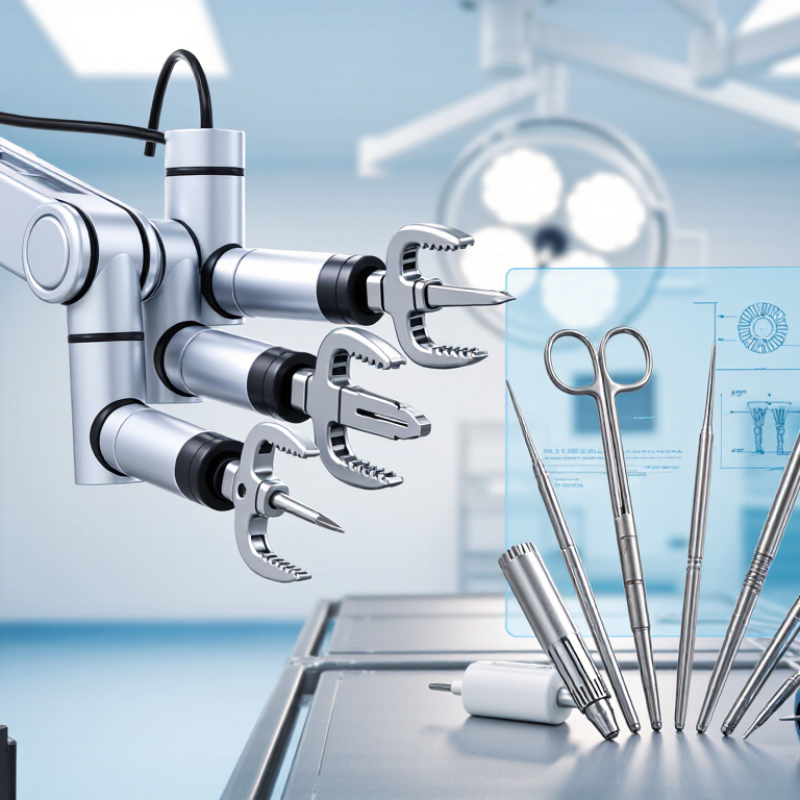
How to Choose Surgical Robotics End Effectors?

Types of Surgical Robotic End Effectors and Their Clinical Roles

How to Choose Surgical Robotics End Effectors?

Types of Surgical Robotic End Effectors and Their Clinical Roles

Surgical robotic end effectors translate console movements into precise tissue handling. Common types include graspers, scissors, needle drivers, bipolar forceps, and monopolar instruments. Graspers stabilize tissue during dissection or retraction. Scissors support controlled cutting around delicate structures. Needle drivers help surgeons place consistent sutures in confined spaces. Energy-based instruments can dissect, coagulate, or seal vessels, but they require careful tissue assessment.

Clinical roles differ by procedure and anatomy. A fine, atraumatic grasper may suit fragile bowel or blood vessels. A stronger, toothed grasper can hold firm tissue, yet it may leave visible marks. Needle drivers need a secure jaw pattern and smooth wrist movement. In my experience, familiar instruments often feel safer, but familiarity can hide poor suitability. Tissue thickness, access angles, bleeding risk, and required force should guide selection. No end effector is perfect.

Tips: Match the instrument to the tissue, not personal habit. Review clinical evidence, surgical guidelines, and validated training protocols. Check jaw geometry, articulation, insulation, cleaning requirements, and compatibility before use. Teams should rehearse instrument exchanges and emergency conversion plans. Watch for thermal spread near nerves or ducts. Document performance during training, because small handling problems can become clinical risks. Feedback from surgeons, nurses, and biomedical specialists adds practical reliability.

Key Surgical Requirements for Selecting an End Effector

Choosing a surgical robotics end effector starts with the procedure, not the device catalogue. Tissue type, access angle, force range, and required motion should guide selection. A grasper for friable tissue needs different jaw geometry than a tool for dense fascia. Fit matters. The surgeon must see the working tip clearly, even through narrow ports and blood-affected fields.

Force control deserves measurable attention. Excessive compression can damage tissue, while weak grip can cause slippage. ISO 14971 risk-management principles support testing these hazards before clinical use. The FDA’s human-factors guidance also emphasizes reducing use-related errors through intuitive controls and realistic simulation. In practice, I would test the end effector with synthetic tissue, wet gloves, awkward angles, and repeated exchanges. Clean-room performance alone is not enough.

Durability and workflow affect safety as much as mechanical precision. Grand View Research valued the global surgical robots market at about USD 7.4 billion in 2023, with strong projected growth through 2030. That expansion increases the need for standardized, evidence-based selection. Reprocessing instructions, cycle limits, cable fatigue, and sterilization compatibility should be documented clearly. A 2023 report from MarketsandMarkets also identified growing demand for minimally invasive procedures, making compact and versatile tools increasingly important. However, versatility can become a weakness. More articulation may increase complexity, cost, and training time. No checklist is perfect. The final choice should combine bench data, surgeon feedback, and procedure-specific evidence.

How to Choose Surgical Robotics End Effectors? - Key Surgical Requirements for Selecting an End Effector

Selection Dimension Surgical Requirement Relevant Technical Data Why It Matters Recommended Evaluation
Procedure and Tissue Type Match the end effector to the target anatomy and intended task, such as grasping, cutting, dissecting, suturing, sealing, or retraction. Required jaw geometry, cutting edge, tissue-contact surface, insulation, and working length. Different tissues have different fragility, elasticity, thickness, and bleeding-control requirements. A tool optimized for one task may cause trauma in another. Create a procedure-specific task list and test the tool on representative tissue models.
Degrees of Freedom Provide sufficient movement for the surgical approach without adding unnecessary mechanical complexity. Distal articulation, wrist rotation, jaw opening, and shaft rotation; many advanced systems provide approximately 5–7 controlled motion axes. Additional articulation can improve access in confined spaces, but may increase control complexity, size, weight, and maintenance needs. Verify reachability, motion range, and collision avoidance around the target anatomy.
Precision and Repeatability Support stable, repeatable positioning during delicate manipulation and microsurgical work. Positioning accuracy, repeatability, backlash, tremor filtering, control resolution, and mechanical stiffness. Small errors can damage vessels, nerves, or sutures. Repeatability is especially important for precise placement and consistent tissue handling. Use calibrated bench tests and task-based trials rather than relying only on nominal specifications.
Force and Load Capacity Generate enough force to grasp, retract, dissect, or close tissue while avoiding crushing and slippage. Maximum jaw force, continuous load, peak load, grip force control, and allowable axial or lateral load. Insufficient force can cause tool slippage; excessive force can produce tissue ischemia, laceration, or unintended deformation. Measure force across the expected tissue range and confirm that overload protection is available.
Haptic and Force Feedback Provide the surgeon with useful information about contact, resistance, tension, and tissue response. Direct force sensing, motor current estimation, tactile sensing, visual force indicators, and feedback latency. Feedback can improve tissue awareness and help reduce excessive force, particularly when direct tactile sensation is limited. Assess feedback accuracy, latency, clarity, and usability during simulated surgical tasks.
Jaw Design and Grip Select a jaw profile that securely handles the intended tissue, suture, needle, or implant. Jaw length, opening angle, serration pattern, atraumatic surface, needle-driving geometry, and closing parallelism. Jaw geometry directly affects grip security, visibility, tissue trauma, needle control, and the risk of accidental release. Evaluate grip on wet, slippery, delicate, and thick tissue analogues.
Size and Access Fit through the selected access route while preserving visualization and instrument maneuverability. Shaft diameter, distal tip diameter, working length, articulation envelope, and insertion-point clearance. Smaller instruments can reduce access trauma, while longer or larger instruments may provide greater strength and reach. Confirm access compatibility using anatomical models and the complete instrument setup.
Energy Delivery For energy-enabled tools, deliver the required cutting, coagulation, sealing, or ablation performance with controlled spread. Energy modality, power range, activation time, thermal spread, insulation, and tissue-thickness range. Uncontrolled energy can cause unintended thermal injury, while inadequate energy may result in incomplete cutting or hemostasis. Review validated performance data and test thermal effects on relevant tissue models.
Visualization and Line of Sight Maintain a clear view of the working tip, target tissue, and surrounding structures throughout the maneuver. Tip profile, jaw visibility, instrument shadow, camera compatibility, and illumination requirements. Poor visibility increases the risk of unintended contact, incomplete placement, and inaccurate cutting or suturing. Assess visibility from typical approach angles and during maximum jaw opening.
Control and Interface Translate surgeon input into predictable, proportional, and stable end-effector motion. Motion scaling, clutching, tremor reduction, response time, command mapping, and activation controls. Intuitive control reduces cognitive load and helps the surgeon perform precise movements consistently. Conduct usability testing with representative users and realistic operating scenarios.
Sterilization and Reprocessing Meet the facility’s validated cleaning, disinfection, sterilization, and inspection workflow. Permitted sterilization method, temperature limits, cycle life, cleanability, and inspection access. Complex joints and narrow channels can retain bioburden if the device is difficult to clean or inspect. Confirm validated instructions for use and review maintenance requirements with sterile-processing staff.
Reliability and Durability Maintain consistent performance throughout the expected operating life and repeated procedures. Cycle rating, joint wear, cable or tendon durability, seal integrity, drop resistance, and failure modes. Mechanical wear can cause backlash, loss of grip, inaccurate motion, or intraoperative interruption. Review life-cycle testing, preventive-maintenance intervals, and failure-recovery procedures.
Safety and Fail-Safe Behavior Prevent unintended motion, uncontrolled energy delivery, accidental release, and excessive tissue loading. Mechanical stops, force limits, emergency release, fault detection, insulation monitoring, and safe shutdown behavior. Predictable failure behavior is essential when power, communication, sensing, or mechanical components fail. Perform hazard analysis and verify emergency procedures under simulated fault conditions.
System Integration Integrate reliably with the robotic arm, control software, imaging system, energy generator, and operating-room workflow. Mechanical interface, electrical connection, software recognition, calibration, data communication, and accessory requirements. Poor integration can cause setup delays, inaccurate calibration, limited functionality, or incompatibility with existing equipment. Complete compatibility testing using the intended robotic platform and operating-room configuration.
Training and Workflow Support efficient adoption by surgeons, assistants, nurses, technicians, and sterile-processing personnel. Setup time, instrument exchange steps, learning curve, task completion time, cleaning complexity, and user training resources. A technically capable end effector may provide limited value if it is difficult to learn, exchange, prepare, or operate consistently. Measure user performance, error rates, exchange time, and training completion requirements.

How Tissue Properties Influence End Effector Design Choices

How to Choose Surgical Robotics End Effectors?
How Tissue Properties Influence End Effector Design Choices

Tissue is not a uniform material. Liver tissue deforms easily, while calcified tissue resists cutting. Vessel walls stretch, recoil, and tear under excessive pressure. These differences should guide jaw geometry, surface texture, force limits, and actuation speed. A 2023 review in Journal of Biomechanics reported wide variation in measured tissue stiffness across organs and testing methods. That variation makes one universal end effector unrealistic. It also makes laboratory results incomplete.

For soft tissue, atraumatic jaws need broad contact areas and controlled closure. Serrations may improve grip, but they can increase local stress. For dense or fibrotic tissue, sharper profiles and higher mechanical advantage may help. Excess force still creates hidden damage. The Lancet Commission on Global Surgery estimated that over 5 billion people lack access to safe, affordable surgical care. Reliable, serviceable instruments therefore matter, especially where advanced maintenance is limited. The 2024 MarketsandMarkets report projected strong double-digit growth for surgical robotics, increasing pressure to validate performance rather than chase speed alone.

Tips: Match the end effector to measured tissue behavior, not procedure labels. Test hydrated specimens at body temperature. Record peak force, slippage, tissue deformation, and recovery time. Include aged or diseased samples. Bench testing is not reality. That assumption needs challenging. Reviewers should also examine sterilization effects, because repeated processing can alter coatings, seals, and jaw alignment. Use risk-based verification under applicable medical-device standards. A promising design can still fail when tissue variability, surgeon feedback, and limited visibility meet in one operation.

How Tissue Properties Influence End-Effector Design

Tissue stiffness varies by several orders of magnitude. Softer tissues generally require compliant, atraumatic jaws with distributed contact pressure, while stiffer tissues require stronger structural support, secure fixation, and higher cutting or grasping loads.

Approximate elastic modulus ranges shown on a logarithmic scale. Values vary with tissue condition, measurement direction, strain rate, and test method; they are intended for conceptual end-effector design comparison rather than clinical specification.

Evaluating Precision, Safety, Sterilization, and System Compatibility

Choosing surgical robotics end effectors requires more than comparing specifications. Precision should be assessed at the tissue level, not only through advertised accuracy. Ask how the instrument performs during fine suturing, grasping, and repeated wrist movements. Test force control with realistic tissue models. Small tremors can become damaging pressure.

Safety begins with controlled motion, reliable locking, and clear feedback. Haptic feedback may support safer handling, but it cannot replace surgical judgment. In operating-room evaluations, teams often notice awkward cable paths or limited visibility. These details can increase fatigue. A practical assessment should include surgeons, nurses, and clinical engineers. Their concerns may differ, and that is useful.

Tips: Check the instructions for use, sterilization cycle, material limits, and maximum reuse count. Confirm that cleaning staff can reach every narrow channel. Ask for documented validation, not verbal assurance. Review connector fit, software communication, and emergency manual release. Compatibility should cover the robotic arm, instruments, imaging, and operating-table workflow. A technically compatible end effector may still create delays. Record setup time and failure points during simulated procedures. Then repeat the test after sterilization. Results can change. No checklist catches every issue, so leave room for cautious revision.

A Step-by-Step Framework for Comparing Surgical End Effectors

How to Choose Surgical Robotics End Effectors?

A Step-by-Step Framework for Comparing Surgical End Effectors

Begin with the procedure, not the device. Define the target tissue, access route, workspace, and required motion. A delicate dissection may need fine articulation and stable grasping. Suturing may require precise needle control. Write these needs down before reviewing specifications.

Next, test functional performance under realistic conditions. Use synthetic tissue, wet surfaces, and narrow access paths. Measure grip stability, jaw alignment, range of motion, and visibility. Check whether the end effector preserves control during repeated movements. Review sterilization requirements, instrument life, maintenance steps, and compatibility with the robotic platform. Clinical evidence should support the design, but laboratory results cannot replace surgeon assessment. No scorecard is perfect.

Tips: Compare force control, not only maximum force. Ask how the instrument behaves after fatigue, cleaning, and repeated use. Include surgeons, nurses, and technical staff in trials. Their feedback may reveal awkward controls or slow setup times. Record failure modes, too. A small delay can matter during a complex step. One practical lesson is easy to miss: the most advanced mechanism may not be the best choice. If training takes too long, consistency may suffer. Reassess the scoring weights after testing. Your first framework will probably need revision.

FAQS

What are the common types of surgical robotic end effectors?

Common types include graspers, scissors, needle drivers, bipolar forceps, and monopolar instruments. Each supports different tissue-handling tasks.

How should surgeons choose a grasper?

Match the jaw to tissue strength and fragility. Broad, atraumatic jaws suit delicate bowel or vessels. Toothed jaws hold firm tissue but may leave marks.

Why does tissue behavior affect end effector design?

Liver tissue deforms easily, while calcified tissue resists cutting. Vessel walls stretch and recoil. Jaw shape, surface texture, force limits, and speed should reflect these differences.

What should be considered when selecting energy-based instruments?

Energy instruments can dissect, coagulate, or seal vessels. Assess tissue thickness and nearby nerves or ducts. Thermal spread can cause unintended injury. More power is not always better.

How can precision and safety be evaluated?

Test fine suturing, grasping, repeated wrist movements, and realistic tissue models. Record slippage, peak force, deformation, and setup time. Small tremors matter.

What compatibility checks are important?

Confirm connector fit, software communication, imaging links, robotic-arm fit, and emergency manual release. Also review table access and instrument-exchange procedures. Technical compatibility may still create delays.

Why are sterilization and cleaning requirements important?

Staff must reach every narrow channel. Repeated processing may change coatings, seals, or jaw alignment. Repeat performance testing after sterilization. Results can change.

How should teams prepare before clinical use?

Rehearse instrument exchanges and emergency conversion plans. Include surgeons, nurses, and biomedical specialists. Document small handling problems. They may become clinical risks.

Can one end effector work well for every procedure?

Probably not. Tissue properties, access angles, bleeding risk, and required force vary widely. Familiar instruments may feel safer, but habit can hide poor suitability.

Conclusion

Choosing Surgical Robotics End Effectors requires a clear understanding of their clinical purpose, tissue interaction, and compatibility with the robotic platform. Different end effectors, such as graspers, scissors, needle drivers, dissectors, and energy-based instruments, support distinct surgical tasks. Selection should consider the procedure, target anatomy, required dexterity, force control, visualization, and the surgeon’s preferred workflow. Tissue properties also play an important role: delicate, elastic, fibrous, or calcified tissues may require different jaw designs, surface textures, articulation ranges, and force limits to reduce trauma while maintaining a secure hold.

A practical comparison should assess precision, responsiveness, safety features, durability, sterilization requirements, and integration with the robotic system. Users should also review instrument ergonomics, maintenance demands, feedback capabilities, and overall cost of ownership. By defining clinical needs first, matching the end effector to tissue characteristics, and then testing performance under realistic conditions, surgical teams can make a balanced decision that supports reliable manipulation, efficient procedures, and consistent patient safety.

Ethan

Ethan

Ethan is a dedicated marketing professional with a strong understanding of the company’s products, services, and customer needs. Through a combination of market insight, strategic thinking, and clear communication, he helps present the company’s value in a practical and engaging way. Ethan......